Los Santos Alive

Inside Los Santos Alive Live

Roll Call

How we built a policing simulation on real procedure, for one of gaming’s most demanding mod communities.

Here the source isn’t fiction. It’s how policing actually works.

Players who live in GTA policing know the codes, the procedure and the rhythm of a shift. They’ve spent a decade building mods to get it right. Roll Call had to meet that standard, and then add people who could think.

Six problems on the beat. And what we did about them.

Each one broke in front of officers who know the job. Here’s what they saw, why it was hard, what we built and where it stands now.

  1. Every callout played out the same way.
  2. Everyone knew the whole story.
  3. The radio sounded like a menu.
  4. The model forgot the procedure.
  5. Scenes that didn’t fit the street.
  6. Two mods, one suspect.

Every callout played out the same way.

In production

What players saw
Traditional callouts are a fixed sequence: one suspect, one victim, one ending. By the third time you’ve seen it, you know the twist.
Why it was hard
A generated incident has to be ready the moment you arrive, fit the exact spot it happens in, and still feel like it was already going on without you.
What we built
The 911 call comes first. The full scene is only built once you accept it, while you drive there, so generation hides inside the gameplay. You arrive mid-incident: people are already arguing, negotiating or fleeing, and a suspect vehicle can be out driving somewhere in the city instead of waiting at a marker.
Where it stands
Players can describe the incident they want, from a domestic dispute to a welfare check that turns into something worse, and the people, conflict and circumstances are built around it.

Where the generation goes

  1. 911 callThe report comes in. Only the call exists yet.
  2. You acceptThe people, their stories and the scene start building.
  3. The driveGeneration finishes while you’re on the road. No loading screen.
  4. You arriveMid-argument, mid-escape, mid-negotiation.

Everyone knew the whole story.

In production

What players saw
In a scripted scene every witness agrees, and the right answer is waiting for you to find it.
Why it was hard
Real incidents don’t come with a narrator. People see different things, remember them wrong and have reasons to lie.
What we built
Every participant is generated with their own name, record, possessions and licences, and their own account of what happened, with its own motives, emotions and misunderstandings. They disagree, misremember and leave things out. Nobody tells you who’s right.
Where it stands
You listen, compare accounts and decide what you believe. What you decide shapes how the report is written.
  • The driver

    “He came out of nowhere. I had a green.”

  • The cyclist

    “She was on her phone. I saw the screen light up.”

  • The man at the bus stop

    “I didn’t see anything.” He did.

Illustration. Three people, three accounts, no narrator.

The radio sounded like a menu.

In production

What players saw
Policing players know radio procedure by heart. A dispatcher who chats, jokes or mangles a callsign breaks the shift instantly.
Why it was hard
Models are chatty, creative and confident. Dispatch has to be none of those things.
What we built
Two real code sets ship, APCO 10-codes and the California Highway Patrol’s, exceptions included. Units get LAPD-style callsigns, spoken the way officers say them, and if a model mixes up two units, each line is put back under the right callsign before anyone hears it. Dispatch never improvises: when a transmission is unclear, it asks for a ten-nine instead of guessing.
Where it stands
Responding units acknowledge in their own voices, report en route and on scene, and talk to each other directly instead of everything going through dispatch.
  1. 1-Adam-12“One-Adam-twelve, ten-ninety-seven on the collision.”
  2. Dispatch“One-Adam-twelve, copy, on scene.”
  3. 2-Adam-14“…Adam-fourteen, en route…”
  4. Dispatch“Unit calling, ten-nine?”
  5. 2-Adam-14“Two-Adam-fourteen, en route, two minutes out.”
Illustration, on the California code set, where 10-97 means on scene and 10-23 means stand by.

The model forgot the procedure.

In production

What players saw
An AI partner who wanders off mid-arrest because a model thought it should is worse than no partner at all.
Why it was hard
Procedure is a fixed order of steps. Conversation is anything but. A stop has to be both.
What we built
Arrests, searches, seating and sobriety tests are protected: once one starts, nothing can interrupt it, and a behaviour only gives way when it can end safely. Inside that, your partner runs a stop the way it’s taught, and stays conversational the whole way through. People read your actual uniform and recognise the agency and rank it stands for.
Where it stands
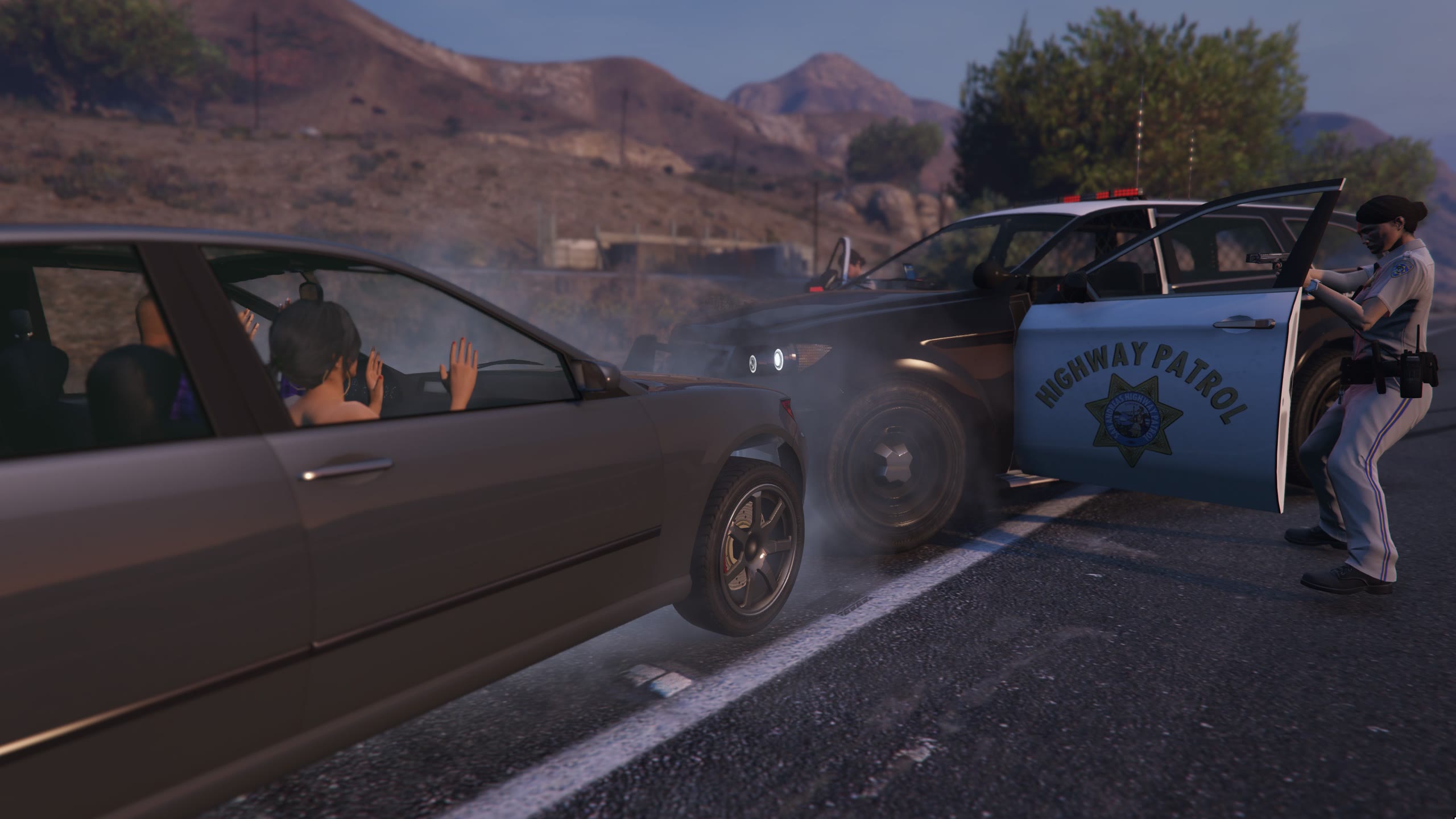
Your partner can now cone off a scene, search a vehicle, test evidence, put a suspect in your cruiser and take the lead on a felony stop. Passengers left in the car talk to each other, and sometimes say what they didn’t want you to hear.

A felony stop, as your partner runs it

  1. Engine off.
  2. Hands where I can see them.
  3. Step out of the vehicle.
  4. Turn away from me.
  5. Walk backwards towards my voice.
  6. Detained.
Every step is spoken, and the driver can still answer back.

Scenes that didn’t fit the street.

In production

What players saw
A model will happily describe a car that doesn’t exist, a back door that isn’t there, or a crash that couldn’t have happened.
Why it was hard
The model is good at the story. It has no idea how big a pickup is, or what’s actually behind that storefront.
What we built
The model writes the story; the game supplies the facts. It asks for “a beat-up pickup” and the game picks a real vehicle that fits the kerb. Rear-ends, head-ons, T-bones and sideswipes are laid out from the vehicles’ actual dimensions. Incidents can only use the spaces, objects and ways in that really exist at that spot.
Where it stands
Dynamic callouts now run across a growing set of locations around Los Santos and Blaine County.

The model writes

“a beat-up pickup, rear-ended at the lights”

The game supplies

  • a real pickup that fits the kerb
  • damage on the correct panels
  • a rear-end laid out from both vehicles’ real dimensions
  • only doors and spaces that exist at that spot

Two mods, one suspect.

In production

What players saw
A driver agrees to cooperate, then suddenly bolts. Not because of anything they said, but because another mod rolled a dice.
Why it was hard
GTA policing runs on a decade of other people’s mods. We can’t replace them, and players won’t give them up.
What we built
We work through that ecosystem, not over it. Every call into the police mods goes through a separate plugin, so if one is missing or fails, Los Santos Alive keeps running. Where two systems would both decide, one does: whether a suspect runs is our call, and a suspect in another mod’s sobriety test is released when that test ends, not on our timer.
Where it stands
Players can write their own department’s procedures into how officers behave, without touching Los Santos Alive, and other policing mods now integrate with us.

Before

  1. “Okay, okay, I’ll cooperate.”
  2. Another mod rolls for resistance.
  3. The driver runs.

Now

  1. “Okay, okay, I’ll cooperate.”
  2. One system decides.
  3. The driver cooperates.
“A fully autonomous stop, where the NPC checks the other one, notices an irregularity and actually arrests him. I was blown away.”
Chad · Los Santos Alive player · October 2026 survey · Translated from French

Building a simulation that has to be right?

We bring the same care to real-world rules as we do to a fictional world.